


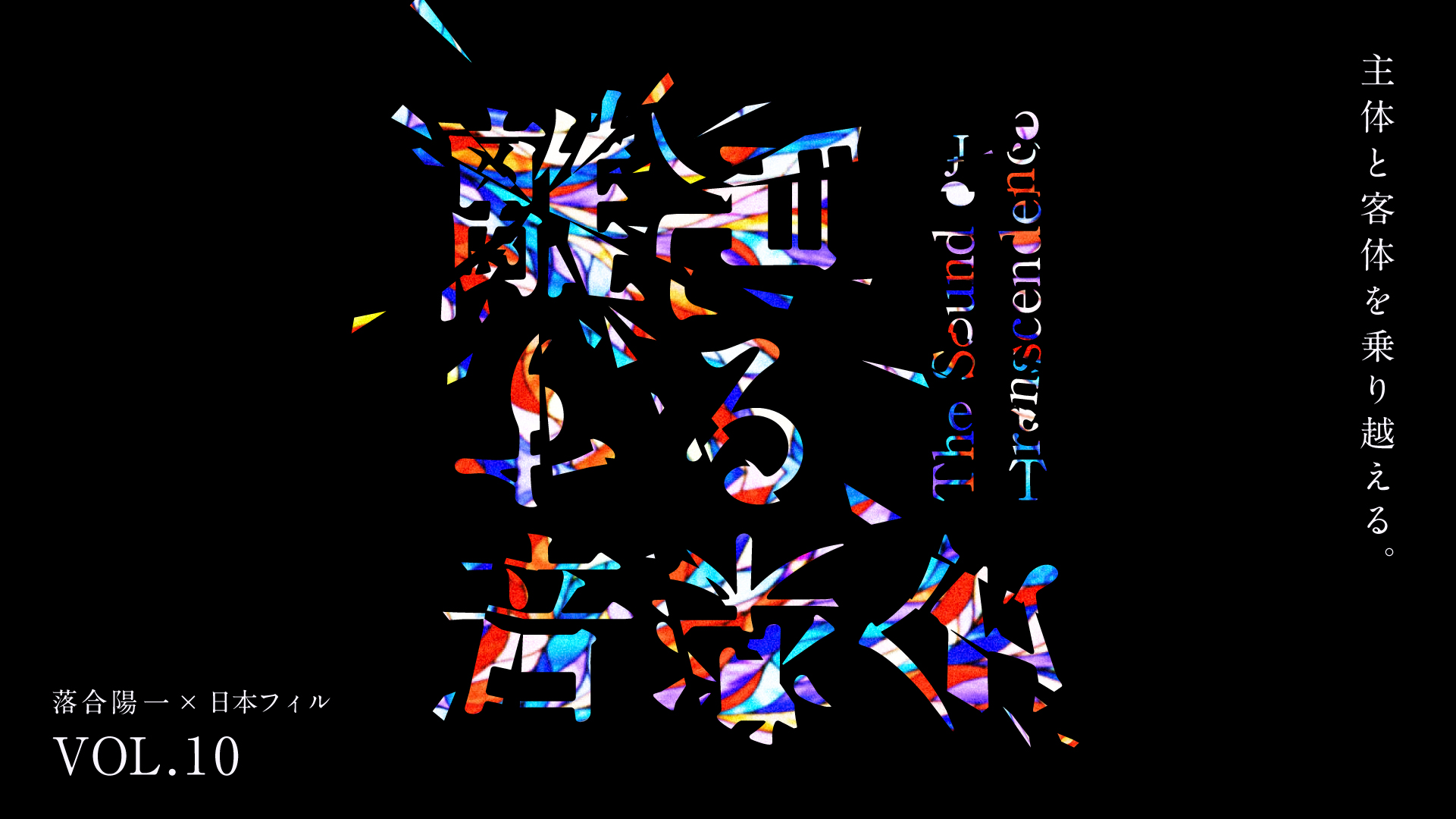


Yoichi Ochiai✕JPO Project VOL.10 《The Sound of Transcendence》 14:00
2026年11月23日 (月) 14:00(13:30 Doors open)
There is a performance at 17:00.
[Yoichi Ochiai Statement]
Up until now, we have been exploring how Western-imported musical structures—such as not listening with the ears, transforming, intersecting, doubling, fermenting, omnipresence, induction, metamorphosis, and null²—can be reconstructed from the perspective of computational nature. Our three-part series with Dai Fujikura, "Open Leaves," "Demon Dance," and "Water Mirror," which followed the path of Ryukyu, Sado, and the World Expo, reached a certain culmination last summer as an attempt to reinvent traditional Japanese music within the context of orchestra and computational nature.
This year, we are bringing the orchestra itself to the Noh stage. The venue is the Yokohama Noh Theatre. The main stage, the bridge, the white sandbar, the four pillars, and the pine tree depicted on the mirror panel. The Noh stage is not merely a performance space. It is a ritual apparatus that contains a vessel in which divine spirits descend, a place where time and space are doubled. When we reorganize the orchestra here, the very modern premise of "performing for the audience" is called into question. On the Noh stage, the performer crosses the bridge from the other shore to this shore, dances on the main stage, and then returns via the bridge. The audience watches this coming and going from a distance, separated by the white sandbar. They are in the same space, yet they do not share the same time.
In his play "Kakyo," Zeami expounded on the concept of "detached viewing." It is the gaze of a performer observing their own dance from the audience, and then from outside the audience, once again from a distance. Eyes before, mind behind—the eyes look ahead, while the mind sees oneself behind. This is a technique of dance, and at the same time, a technique of perception. In the realm of computational nature, which I have long contemplated, the most pressing question now is how humans can maintain the gaze that observes their own subjectivity as an object. AI is watching me. Data is calculating me. Can I, as an object in that calculation, still maintain the detached viewing as a subject? The Noh stage is a response to that question from 600 years ago.
Just as performers observe themselves from afar, we too re-examine our own civilization and sensibilities from a distance through the Noh stage, a 600-year-old apparatus of observation. Audience and performers, nature and culture, humans and computers, past and future. We distance ourselves from these distances, and then bring them closer again. We want to witness the moment when sound arises in that interplay. Across the white sand of the Yokohama Noh Theatre, from the far end of the bridge, before the Yōkō no Matsu pine tree, the orchestra of computer-nature stands. The sound of detachment begins to resonate now.
Performer
Directed by: Yoichi Ochiai
Shite (main actor) of the Kanze school: Noriaki Umewaka (Noh theater supervisor, performer)
Shite (main actor) of the Kanze school: Umewaka Kagehide
Musicians: Flute/Yusuke Kuribayashi, Small hand drum/Komei Iitomi, Large hand drum/Keinosuke Okura, Taiko drum/Masato Kodera
Chorus: Takayuki Matsuyama, Kohei Kawaguchi, Tomomasa Yamazaki, Yuki Washio
Members of the Japan Philharmonic Orchestra
Violin: Masaaki Tanokura [Solo Concertmaster]
Violin: Sayumi Suehiro
Viola: Motomichi Konakazawa
Cello: Hiroi Kadowaki [Solo Cello]
Flute: Keiko Manabe [Principal player]
Program
Debussy (Isao Tomita): Moonlight <4-channel synthesizer sound source>
NOH-PLAY[IZUTSU] excerpt
J.S. Bach: Sonata for Solo Violin No. 2, XNUMXst Movement "Grave"
Dohnányi: Serenade for String Trio, op. 3, XNUMXrd movement
NOH-PLAY[ARASHIYAMA] excerpt
Toru Takemitsu: Air for Flute (XNUMX)
NOH-PLAY[YAMAMBA] excerpt
Pärt: Summa (XNUMX)
Ravel: String Quartet in F-major etc
Price
[All seats reserved, tax included]
SS: 10,000 yen *Available only through Japan Philharmonic Orchestra and READYFOR
S: 8,000 yen
A: 6,000 yen
Ys (ages 25 and under, select from A seats) / Wheelchair user / accompanying person (up to 1 person): 2,500 yen *Available only at the Japan Philharmonic Orchestra
Diversity discount (for holders of disability certificates): SS: 5,000 yen, S: 4,000 yen, A: 3,000 yen. *Available only at the Japan Philharmonic Orchestra.
Crowdfunding on READYFOR: A Detached Concert | 11/23 Transcending Subject and Object.
September 1st (Tue) - November 30th (Mon) [Tickets and rewards with your name listed in the program are available until November 5th (Thu)]
We offer various options, including a ticket & original T-shirt course, a ticket & special event course where you can interact with the performers, and a course where you can support us by purchasing merchandise! Please support the project as a fellow member of the music community.
https://readyfor.jp/projects/vol10
[Performance Features]
①What does it mean to "see," and what does it mean to "be seen"?
Starting with "not listening with the ears," and progressing through "transformation," "intersection," "fermentation," "omnipresence," "induction," and "mutation," Yoichi Ochiai and the Japan Philharmonic Orchestra have spent eight years re-examining the role of Western orchestras in contemporary Japan. This year, their journey culminates in an encounter with the Noh concept of "detached observation"—a gaze that looks at oneself from a distance. In an age where we are seen by AI and calculated by data, how can we re-examine ourselves? This question is embodied within the architecture of the Noh stage itself. This new frontier was only reached thanks to the accumulation of eight years of project work. Hints of the answer lie in the "exchange" between the stage and the outside world.
② Enter the Noh stage.
Up until now, we've brought traditional music into the world of orchestras. This time, members of the Japan Philharmonic Orchestra will step into the sacred space of the Yokohama Noh Theatre, a place with a 600-year history. The Noh stage is a place of dedication to the gods. What will happen when the Japan Philharmonic Orchestra lets go of the norm of "playing for the audience"? This will be the smallest ensemble in the series' history, yet the biggest step forward.
③ The Noh performer takes on the role of a "co-creator" rather than a "performer."
Under the supervision of Noh theater by Noriaki Umewaka, a holder of an Important Intangible Cultural Property designation, and with planning cooperation from Genjiro Okura, both the program and direction are constructed from the very grammar of Noh. The warp thread is "Noh," and the weft thread is "classical music." This is a collaborative production in which the two performing arts resonate with each other on the same stage, creating a "story" in the form of a single performance.
4 The unfolding story is a new "nature"
Beginning with "Moon," followed by "Night," "Flowers," "Wind," and "Color," the program alternates between Western music and Noh theater, yet the whole is woven together as a single, uninterrupted emotional journey. The "wind" that blows through this journey is Yoichi Ochiai's video direction. It's not a fragmented collaboration, but a structure that makes you want to watch it from beginning to end.
⑤ A stage production that could never have been created anywhere but Yokohama.
Yokohama, a port city that has gracefully embraced foreign cultures. The Yokohama Noh Theatre, rebuilt through the efforts of its citizens, just reopened in 2026 after two and a half years of renovations. For the Japan Philharmonic Orchestra, which is celebrating its 70th anniversary, Yokohama is a special place where it started its regular concerts about 50 years ago with the help of its citizens and made a fresh start after overcoming adversity. In this city, which will host GREEN EXPO 2026 with nature as its theme, a day that can only happen here and now will begin on the reborn Noh stage.
⑥ It's not just about "watching" from the audience.
Rehearsal observation, lunch and talk with the performers, post-performance networking events—through crowdfunding, we've prepared opportunities that go beyond simply "watching" and allow you to delve into the depths of the stage. Join us on this journey from the moment the concert is born to what lies beyond, and become a "proactive" participant in creating the stage together.
Ticket Sales
Play guide:
eplus
(From within Japan:) https://eplus.jp/yoichiochiai-jpoproject_10/
(for international orders:) https://eplus.tickets/yoichiochiai-jpoproject_10/
Ticket Pia https://w.pia.jp/t/japanphil/
Yokohama Noh Theatre (Ticket sales only at the counter, 9:00 AM to 18:00 PM, excluding facility maintenance days)
[Organizer, Planner, and Producer] Japan Philharmonic Orchestra
Japan Expo 2026 (Japan Arts Council / Agency for Cultural Affairs)

[In cooperation with] Jisekai Inc. / Yokohama Noh Theatre (Yokohama Arts and Culture Foundation) / TOMITA information Hub / Nippon Columbia Co., Ltd. / TBWA_HAKUHODO
[Equipment Sponsorship] Seibido Co., Ltd.
Find a concert
Featured keywords